
27 Feb 2026
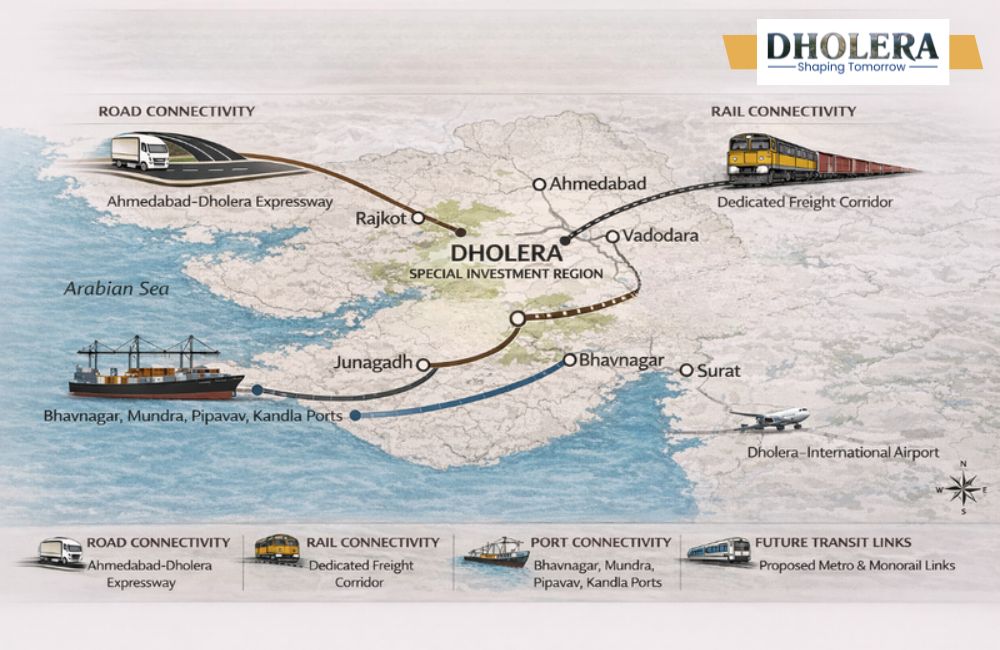
Connectivity has been identified as one of the most critical pillars of development at the Dholera Special Investment Region (SIR), with planners emphasising integrated transport networks as essential for long-term industrial and urban viability. Designed as part of the Delhi–Mumbai Industrial Corridor (DMIC), Dholera is being developed with road, rail, air, and port connectivity planned simultaneously rather than incrementally.
This multi-modal approach is intended to support manufacturing, logistics, and trade activity while reducing transport costs and travel time. Officials involved in the project state that connectivity readiness is fundamental to ensuring that industrial and commercial zones function efficiently once operations scale up.
Dholera SIR is strategically located in Ahmedabad district, positioned between major urban and industrial centres such as Ahmedabad, Vadodara, Rajkot, and Bhavnagar. This location places it within Gujarat’s established economic geography while allowing space for large-scale greenfield development.
The region also benefits from Gujarat’s extensive coastline of nearly 600 kilometres, supported by 42 ports that together handle a significant share of India’s maritime cargo. Dholera’s planning framework seeks to leverage this existing trade ecosystem through improved inland connectivity.
Road connectivity forms the backbone of Dholera’s transport network. The Ahmedabad–Dholera Expressway, spanning approximately 109 kilometres, is a key infrastructure component connecting the emerging smart city with Gujarat’s largest urban centre.
The expressway significantly reduces travel time between Ahmedabad and Dholera, enabling faster movement of goods, workers, and services. It is expected to serve both industrial logistics and daily commuting needs as development progresses.
Within the SIR, road networks have been planned with wide right-of-way, service roads, and designated utility corridors. This design allows for future capacity expansion without disrupting existing infrastructure.
Rail infrastructure plays a central role in Dholera’s logistics strategy. The city is integrated into the Dedicated Freight Corridor (DFC), a flagship project under the DMIC aimed at creating high-capacity, high-speed freight rail networks across India.
More than 700 kilometres of the DFC are already operational across different stretches, with full functionality expected in the coming years. Once fully operational, the corridor is expected to facilitate faster and more reliable movement of industrial goods between production centres and ports.
For Dholera Greenfield Smart City, this integration is particularly important given its focus on manufacturing and export-oriented industries. Rail connectivity reduces dependence on road transport and helps lower logistics costs for bulk and long-distance cargo.
The upcoming Dholera International Airport at Navagam is another significant component of the city’s connectivity framework. The airport is nearing completion and is expected to become operational by March 2026, according to project planning timelines.
The airport has been planned to handle both passenger and cargo traffic. Cargo operations, in particular, are expected to support time-sensitive manufacturing sectors and high-value exports.
Once operational, the airport is expected to complement existing aviation infrastructure in Gujarat while improving access to global markets.
Dholera’s proximity to major ports such as Bhavnagar, Mundra, Pipavav, and Kandla strengthens its role in regional and international trade. These ports are already integral to Gujarat’s export economy, handling commodities ranging from industrial goods to energy products.
Planners have emphasised road and rail linkages between Dholera and these ports to ensure seamless cargo movement. Efficient port access is considered essential for export-oriented manufacturing units planned within the SIR.
In addition to conventional transport modes, future connectivity plans include high-speed metro and monorail links connecting Dholera with Ahmedabad and GIFT City. While these systems are part of longer-term planning, they reflect an effort to integrate Dholera SIR into the broader regional mobility network.
Such transit links are expected to support workforce mobility and reduce reliance on private vehicles, contributing to sustainable urban growth.
Urban planners note that Dholera’s connectivity strategy reflects a logistics-led development model. Rather than treating transport infrastructure as a secondary consideration, the city’s design integrates logistics planning into land use and zoning decisions.
This approach aims to prevent congestion, reduce environmental impact, and support efficient movement of goods and people over the long term.
As connectivity infrastructure continues to progress, Dholera SIR is increasingly viewed as a critical node within Gujarat’s transport and trade network. The effectiveness of this multi-modal framework will become clearer as industrial and urban activity expands in the region.
Your information is safe with us. By submitting, you agree to our privacy policy and terms of use.