
23 Feb 2026
India’s digital economy is expanding at record speed. But every digital revolution needs a physical backbone.
The proposed ₹25,000 crore hyperscale AI-ready data centre campus in Dholera is not just another infrastructure headline—it represents a structural shift in how India is preparing for artificial intelligence, cloud computing, and next-generation enterprise workloads.
Let’s unpack what this development truly means for Gujarat, investors, enterprises, and India’s digital future.
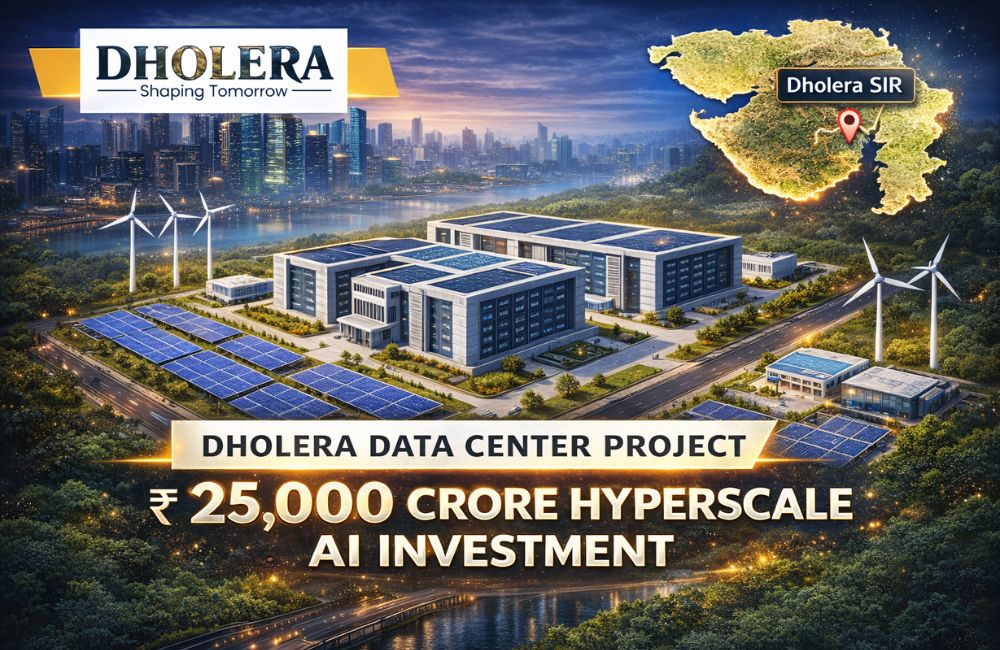
The upcoming hyperscale data infrastructure project is planned as a massive 250 MW AI-ready campus within the Dholera Special Investment Region (SIR) in Gujarat.
Key highlights shaping industry discussions:
Unlike traditional urban data centres that expand incrementally, this Dholera Data Center project is being conceptualized as foundational digital capacity from day one.
This is long-term digital infrastructure creation not incremental growth.
Large hyperscale data centres require three non-negotiables:
Dholera offers something rare in India—a fully planned greenfield smart city environment.
Instead of retrofitting into dense metro cities, developers here benefit from:
This creates a future-ready environment that hyperscale AI operators demand.
To understand the scale, 250 MW does not mean a single building.
It typically translates into:
Facilities of this size are designed to support:
In practical terms, this is digital backbone capacity for the next decade.
Artificial Intelligence workloads require far more power and cooling than traditional data storage.
Industries currently driving AI demand include:
AI infrastructure demands:
Dholera’s planned ecosystem aligns with these requirements, making it strategically relevant at exactly the right time.
Modern hyperscale facilities cannot ignore ESG expectations.
The project discussions indicate a strong emphasis on:
If implemented effectively, this could position Gujarat as a benchmark for green AI infrastructure in India.
Long-term sustainability metrics will define investor confidence and global cloud partnerships.
For years, Mumbai and Chennai have dominated India’s hyperscale data centre market.
However, metro challenges include:
Dholera changes the equation by offering:
This diversification reduces pressure on existing hubs and opens Western India as a serious digital infrastructure corridor.
Data centres themselves are not highly labour-intensive—but their ecosystems are.
When hyperscale infrastructure arrives, it often triggers:
Over time, this can influence land demand cycles, especially in smart industrial zones.
However, such impacts are gradual and tied to execution timelines—not instant speculative spikes.
If you are a cloud provider, enterprise CIO, or AI platform evaluating future hosting capacity, key questions include:
Greenfield advantages provide flexibility—but operational excellence determines credibility.
A 250 MW campus generates demand across multiple verticals:
Early ecosystem participants often gain long-term multi-phase partnerships.
Timing is critical.
Dholera has long been positioned as a future-ready smart industrial region.
Manufacturing brings industrial gravity.
Digital infrastructure brings technological gravity.
When both converge, the narrative shifts from “potential” to “structural growth.”
A hyperscale AI campus signals confidence in:
Execution will ultimately determine the scale of impact—but the signal itself is strong.
It’s important to separate structural opportunity from short-term hype.
Large infrastructure projects:
For investors, enterprises, and stakeholders, the focus should remain on:
That’s where real value—and real risk—exists.
The ₹25,000 crore hyperscale AI data campus in Dholera Smart City represents more than a single infrastructure project.
It reflects India’s transition toward large-scale digital backbone creation.
In a world driven by AI, cloud computing, and enterprise digitization, physical infrastructure determines competitive advantage.
If executed effectively, this development could position Gujarat as a significant player in India’s digital infrastructure ecosystem.
But as with all large-scale projects, the real story will unfold in the details—power agreements, sustainability benchmarks, construction phases, and operational execution.
The headlines signal ambition.
Execution will define legacy.
1. What is the planned capacity of the Dholera AI data centre project? The campus is expected to scale up to around 250 MW in multiple phases.
2. Is the project AI-ready? Yes, it is being positioned as a hyperscale AI-ready infrastructure facility.
3. Will renewable energy be used? Project discussions emphasize renewable integration, though detailed energy mix disclosures will define sustainability impact.
4. How does this compare to Mumbai data centres? Mumbai remains dominant, but Dholera offers scalable land and greenfield planning advantages.
5. Is the project operational? The development has been announced; execution will unfold in structured phases.
6. Who benefits most from this project? Cloud providers, AI enterprises, infrastructure vendors, enterprises, and long-term regional development stakeholders.
Your information is safe with us. By submitting, you agree to our privacy policy and terms of use.