
14 May 2026
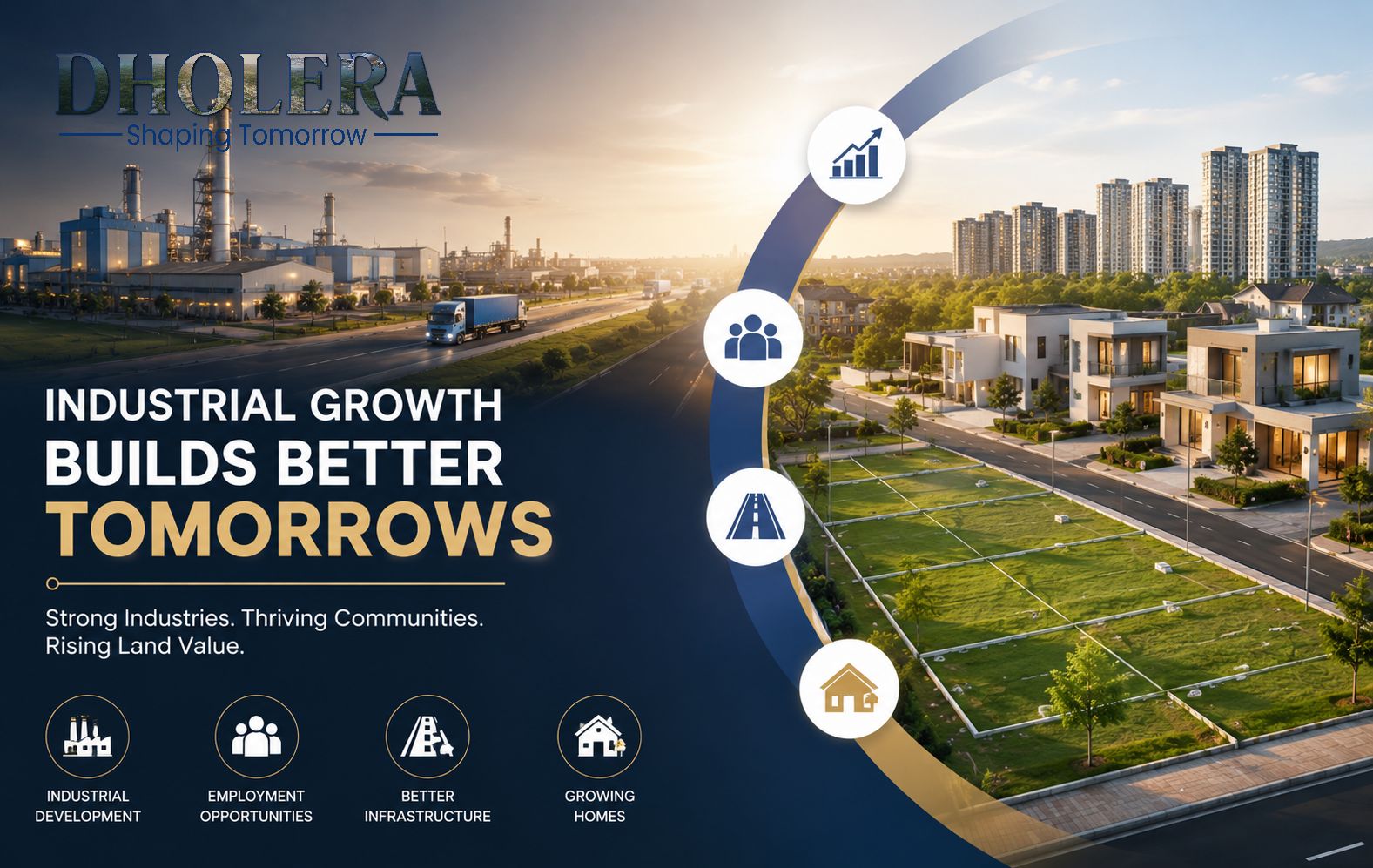
The relationship between industrial growth and residential real estate has long been a defining factor in urban expansion. Across both developed and emerging economies, the establishment of industrial zones has consistently influenced where and how people choose to live. As industries expand, they generate employment, improve infrastructure, and attract population inflows—each of which contributes to increased demand for housing and, more fundamentally, for land.
In the context of emerging regions such as Dholera SIR, this relationship becomes even more significant. Planned industrial development in such areas is not only shaping economic activity but also laying the groundwork for future residential ecosystems. Understanding how this process works is essential for investors, planners, and end-users alike.
Industrial development serves as a primary driver of economic activity within a region. Manufacturing units, logistics hubs, and technology parks create direct employment opportunities across various skill levels. In addition to these direct jobs, a wide range of indirect employment is generated through supply chains, services, and supporting industries.
As job opportunities increase, people move closer to these economic centers. This migration is not limited to workers alone; it includes families, entrepreneurs, and service providers. Over time, this influx of population creates a sustained need for residential spaces.
At its core, the demand for residential land is closely tied to the presence of economic activity. Without employment opportunities, real estate growth tends to remain speculative. However, when industries establish a long-term presence, housing demand becomes more stable and predictable.
One of the most immediate effects of industrial development is population growth in surrounding areas. Workers relocating for employment require accommodation, whether in the form of rental housing, owned properties, or plotted developments for future construction.
This population inflow often triggers a chain reaction. As more people settle in the region, the need for essential services—such as retail, healthcare, education, and transportation—increases. These services, in turn, attract additional businesses and professionals, further expanding the local economy.
Over time, what begins as an industrial zone evolves into a more comprehensive urban environment. Residential land becomes a critical component of this transformation, providing the space needed to accommodate a growing population.
Industrial projects rarely develop in isolation. They are typically supported by large-scale infrastructure investments, including roads, rail connectivity, power supply, and water management systems. Governments and private stakeholders often prioritize such infrastructure to ensure the smooth functioning of industrial operations.
This improved infrastructure has a direct impact on surrounding land values. Areas that were previously considered remote or underdeveloped become more accessible and attractive for residential use. Connectivity reduces travel time, making it feasible for people to live at a distance from their workplaces without compromising convenience.
In regions like Dholera, where infrastructure is being planned alongside industrial growth, this effect is even more pronounced. The simultaneous development of economic and physical frameworks creates a strong foundation for long-term residential demand.
In the early stages of industrial development, accommodation needs are often met through temporary housing solutions such as rental units or shared living arrangements. However, as industries stabilize and workforce retention becomes important, there is a gradual shift toward permanent settlement.
Employees who anticipate long-term employment in a region are more likely to invest in land or housing. This transition from temporary to permanent residency significantly increases demand for residential plots in Dholera SIR, as buyers seek flexibility in building homes according to their preferences.
Plotted developments, in particular, appeal to individuals who view land ownership as both a lifestyle choice and a financial asset. The ability to construct homes at a later stage allows buyers to align their investment with personal and economic circumstances.
Industrial zones do not operate in isolation; they give rise to entire ecosystems of supporting activities. Retail outlets, restaurants, schools, hospitals, and entertainment facilities gradually develop to cater to the needs of the growing population.
This ecosystem enhances the livability of the region, making it more attractive for families rather than just individual workers. As social infrastructure improves, the perception of the area shifts from being purely industrial to being a viable residential destination.
Land located within or near such evolving ecosystems tends to gain value over time. Buyers are not just investing in a piece of land, but in the future potential of a well-rounded community.
Industrial development also influences investor behavior. When large-scale projects are announced or initiated, they signal long-term economic commitment to a region. This often attracts investors who anticipate future growth in real estate demand.
Residential land in Dholera becomes a preferred investment option in such scenarios due to its relatively lower entry cost compared to built properties and its potential for appreciation as development progresses. However, it is important to distinguish between speculative activity and genuine demand.
Sustainable growth in land value is typically supported by actual industrial progress and population settlement, rather than short-term market sentiment. Investors who understand this distinction are better positioned to make informed decisions.
From a planning perspective, the integration of industrial and residential zones is essential for creating balanced urban environments. Excessive separation between workplaces and living areas can lead to long commutes, increased congestion, and reduced quality of life.
Modern urban planning aims to minimize these challenges by promoting mixed-use development and strategic zoning. In planned regions, residential land is allocated in proximity to industrial and commercial areas, ensuring that growth is both efficient and sustainable.
This approach not only enhances convenience for residents but also supports the long-term viability of the region. As a result, demand for residential land becomes an integral part of the overall development strategy.
While the link between industrial growth and residential demand is well-established, it is not without challenges. The pace of industrial development can vary, and delays in project execution may impact the expected timeline of residential demand.
Additionally, environmental concerns, regulatory changes, and economic fluctuations can influence both industrial and real estate markets. Buyers and investors must consider these factors when evaluating opportunities in emerging regions.
Another important consideration is the quality of planning and execution. Poorly managed development can lead to issues such as overcrowding, inadequate infrastructure, and declining living standards. Therefore, the success of residential growth depends not just on the presence of industry, but on how well the overall ecosystem is managed.
Industrial development plays a fundamental role in shaping residential land demand by creating employment, attracting population, and driving infrastructure growth. This interconnected process transforms regions from economic hubs into fully developed urban environments.
In emerging areas like Dholera SIR, this relationship is particularly relevant. The planned integration of industrial and residential zones provides a framework for sustainable growth, where land demand is supported by tangible economic activity rather than speculation alone.
For investors and future homeowners, understanding this dynamic is crucial. Residential land in such regions is not merely a static asset—it is part of a larger development narrative that unfolds over time.
As India continues to invest in industrial corridors and smart cities, the connection between economic growth and real estate demand will remain a key driver of urban expansion. Recognizing this link allows stakeholders to approach land investment with greater clarity, realism, and long-term perspective.
Your information is safe with us. By submitting, you agree to our privacy policy and terms of use.