
27 Feb 2026
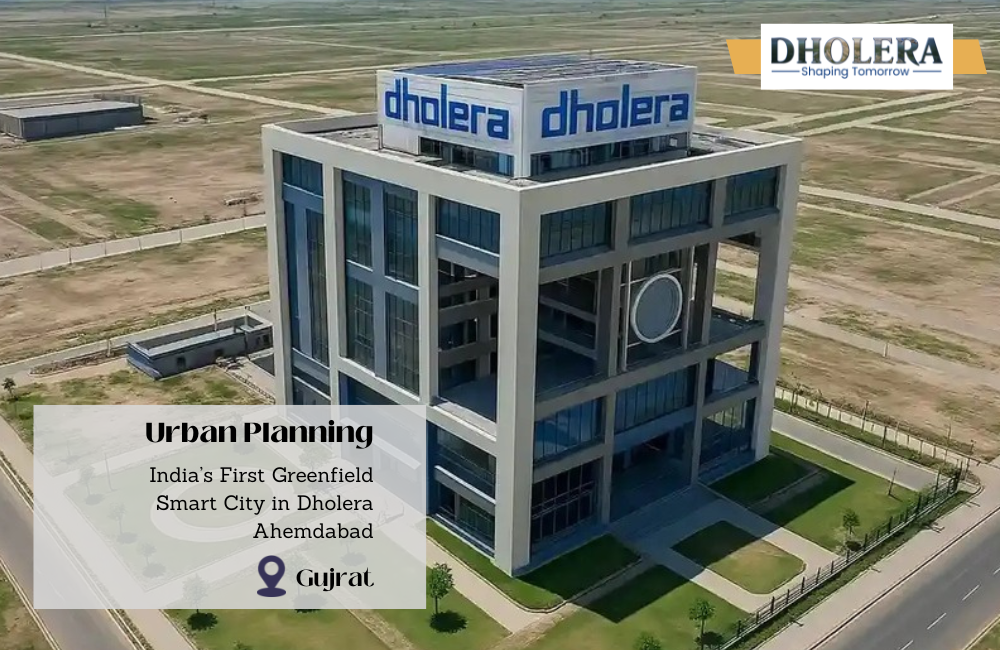
The development of Dholera Special Investment Region (SIR) represents one of India’s most comprehensive attempts to plan and govern an urban-industrial region entirely from scratch. Unlike conventional cities that evolve through incremental growth, Dholera has been conceived as a greenfield smart city with predefined land use, infrastructure corridors, and administrative frameworks.
The planning and governance model adopted for Dholera is rooted in long-term urban management principles, combining statutory regulation, phased development, and technology-enabled administration. Project authorities describe the region as a planned response to challenges faced by older urban centres, including congestion, infrastructure retrofitting, and fragmented governance.
Dholera SIR is being developed over an area of approximately 920 square kilometres in Ahmedabad district along the Gulf of Khambhat. The greenfield nature of the project has allowed planners to design the city without constraints imposed by existing dense settlements or legacy infrastructure.
From the outset, land use planning, infrastructure corridors, industrial zones, residential areas, and social infrastructure have been mapped in an integrated manner. This approach contrasts with traditional urban expansion, where residential and commercial development often precedes infrastructure provisioning.
Planners involved in the project have highlighted that advance planning enables predictable growth patterns, controlled land use, and efficient service delivery over the long term.
The spatial organisation of Dholera SIR is structured through six Town Planning (TP) schemes, designated TP-1 through TP-6. These schemes collectively cover 22 villages and are further divided into 15 planning zones.
Each TP scheme functions as a self-contained planning unit with clearly defined allocations for:
This modular planning structure allows development to proceed in phases, ensuring that infrastructure capacity aligns with population and industrial growth.
Total Area: 920 sq. km
Town Planning Schemes: 6 (TP-1 to TP-6)
Zones: 15
Villages Covered: 22
Development Approach: Phased, zone-wise
The governance of Dholera SIR is anchored in a statutory framework established under the Special Investment Region (SIR) Act. This legislation provides the legal basis for land pooling, development control regulations, infrastructure planning, and administrative authority.
Under this framework, development within the SIR is guided by approved master plans and zoning regulations. These controls are intended to prevent unplanned construction and ensure that land use aligns with the city’s long-term objectives.
Land parcels within the region are protected under relevant state laws, and development activities are subject to regulatory approvals. Officials note that such legal clarity is essential for managing large-scale urban regions over multiple decades.
The development and governance of Dholera SIR Gujarat are being carried out through a joint Centre–State institutional framework. The Government of Gujarat plays a central role by contributing land and overseeing local administration, while the Government of India provides policy support and funding through the Delhi–Mumbai Industrial Corridor mechanism.
A dedicated development authority has been constituted to manage planning, infrastructure execution, and regulatory oversight within the SIR. This authority is responsible for:
The use of a single-purpose development authority is intended to reduce administrative fragmentation, a common challenge in large urban regions.
Urban planning and infrastructure design at Dholera have involved the participation of international and domestic professional agencies. Global consulting firms and Indian engineering companies have been engaged for master planning, detailed engineering design, project management, and execution.
These agencies have contributed expertise in areas such as:
Officials involved in the project state that global best practices were adapted to local conditions rather than applied uniformly, recognising regional climatic, geographic, and socio-economic factors.
A key feature of Dholera’s urban model is the integration of infrastructure planning into the city’s governance framework. Roads, utilities, drainage, and public services have been designed alongside land use planning rather than as afterthoughts.
The city incorporates underground networks for water supply, electricity, gas, and data, reducing visual clutter and maintenance disruptions. Drainage and stormwater systems are integrated with engineered water bodies designed for flood management and rainwater harvesting.
This integrated planning model is expected to reduce long-term operational costs and improve service reliability, although its effectiveness will depend on sustained maintenance and governance capacity.
Dholera’s governance model places significant emphasis on technology-enabled administration. A centralized Integrated Command and Control Centre (ICCC) has been planned to monitor and manage city operations in real time.
The ICCC is expected to integrate data from multiple systems, including:
By consolidating information across departments, the system aims to support faster decision-making and coordinated responses to operational challenges.
Urban governance experts note that while such systems can improve efficiency, their success depends on institutional capacity, skilled personnel, and clear protocols for inter-departmental coordination.
Urban planning at Dholera extends beyond industrial and transport infrastructure to include social services required for a functioning city. Project plans include provisions for schools, healthcare facilities, commercial centres, and recreational spaces.
Integrated schools, hospitals with significant bed capacity, and community facilities are planned within residential and mixed-use zones. The aim is to reduce the need for long-distance commuting and support a balanced urban environment.
Planners emphasise that social infrastructure is being developed in parallel with industrial growth to avoid the creation of dormitory settlements lacking essential services.
Sustainability has been incorporated into Dholera’s planning framework through measures such as green building standards, renewable energy integration, and water management systems. The city has been recognised for its greenfield planning approach and environmental certifications.
Environmental clearance processes were undertaken during the planning stages, and mitigation measures were integrated into design elements such as drainage systems and open spaces.
Urban analysts caution, however, that maintaining environmental standards over time will require continuous monitoring and enforcement as development intensifies.
While Dholera’s planning and governance model has been widely noted for its scale and ambition, experts point out that long-term success will depend on consistent policy implementation, coordination among agencies, and adaptability to changing economic conditions.
Large greenfield cities often face challenges related to phased occupancy, revenue generation for maintenance, and alignment between planned and actual land use. How Dholera’s governance structures respond to these challenges will shape its evolution over the coming decades.
Dholera smart city stands as a significant experiment in planned urban governance in India. By combining statutory authority, phased development, integrated infrastructure, and technology-enabled administration, the project seeks to address structural issues that have constrained older cities.
As development continues, Dholera’s governance framework will be closely observed by policymakers, urban planners, and infrastructure experts. Its outcomes are expected to influence future greenfield city initiatives and large-scale urban development projects across the country.
Your information is safe with us. By submitting, you agree to our privacy policy and terms of use.