
17 Feb 2026
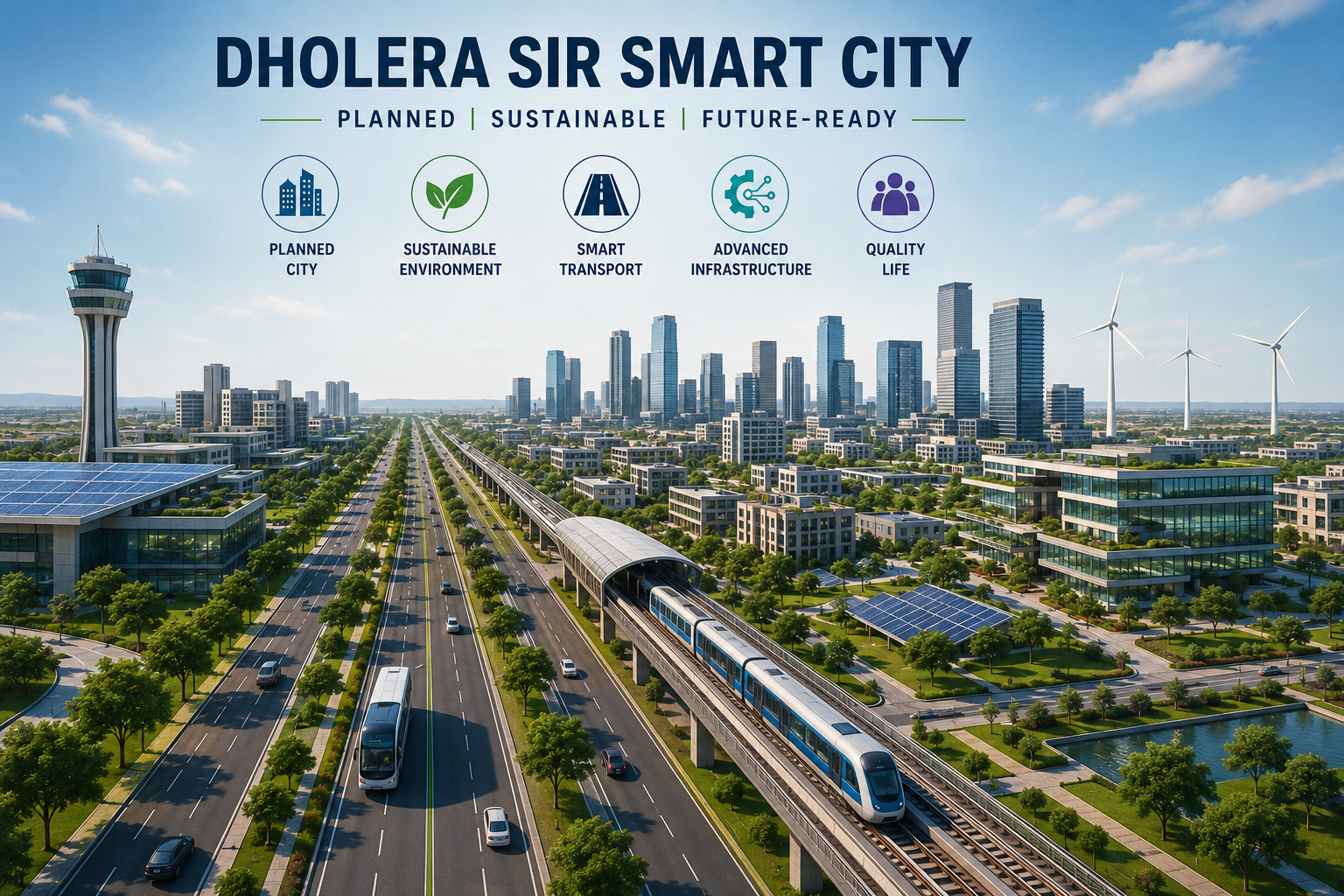
India is experiencing rapid urban growth, making city planning and infrastructure development increasingly important. As urban populations continue to expand, the need for organized development, efficient public services, and sustainable infrastructure has become a major focus for planners and policymakers. In response to these requirements, several large-scale urban development initiatives have been introduced across the country. One such project is Dholera SIR Smart City, a planned greenfield development located in the state of Gujarat.
Dholera Special Investment Region (SIR) has been designed as a modern urban development project built through a comprehensive planning framework. Unlike many traditional cities that have expanded gradually over decades, Dholera is being developed according to a predefined master plan that integrates transportation, infrastructure, residential areas, industrial zones, public facilities, and environmental considerations. The project is often discussed in the context of smart city development and contemporary urban planning in India.
Dholera Special Investment Region is a large-scale planned urban development project situated in Gujarat. It is recognized as one of India's major greenfield city developments. A greenfield project refers to development that takes place on previously undeveloped land, allowing planners to design urban infrastructure and services from the beginning rather than adapting existing systems.
The concept behind Dholera is based on creating a city where different aspects of urban life are integrated through systematic planning. Land use, transportation, utilities, governance systems, public services, and environmental management are considered together during the planning process. This approach helps establish a structured urban framework capable of supporting long-term development requirements.
The city has been planned with designated areas for different functions, ensuring that residential, industrial, commercial, and public service zones operate within an organized layout.
Dholera is located in Gujarat, a state known for its industrial activities, transportation networks, and infrastructure development initiatives. The project's location provides sufficient space for large-scale urban planning while supporting regional connectivity.
One of the notable aspects of the location is the availability of land required for comprehensive city development. This enables planners to incorporate transportation corridors, utility infrastructure, public facilities, green spaces, and development sectors within a structured framework.
The region has been identified as suitable for planned urban expansion due to its capacity to accommodate future infrastructure requirements while maintaining organized land-use patterns. Such planning helps avoid many of the challenges associated with unregulated urban growth, including congestion, inefficient infrastructure placement, and fragmented development.
The planning vision for Dholera focuses on creating a modern urban environment supported by organized infrastructure and efficient administration. The development framework has been designed to promote coordinated growth through clearly defined planning objectives.
Some of the key elements of this vision include:
Rather than allowing development to occur incrementally without coordination, the project follows a master plan intended to guide growth according to predefined standards and planning principles.
A defining feature of Dholera is its master-planned approach. Master planning involves creating a long-term blueprint that determines how different parts of a city will function and interact with one another.
This planning process includes the allocation of land for various purposes, including residential areas, industrial sectors, transportation infrastructure, public facilities, utility networks, and environmental zones. By establishing these elements in advance, planners can coordinate development activities more effectively.
The master plan also helps ensure consistency in infrastructure standards and land-use policies. Such an approach supports organized development while reducing the likelihood of unplanned expansion.
Comprehensive planning is particularly important for large urban projects because it enables infrastructure systems and public services to be integrated into the city’s overall design from the beginning.
Infrastructure forms the foundation of any urban area, and Dholera places significant emphasis on planned infrastructure development. The city’s infrastructure framework has been designed to support transportation, utilities, communication systems, and public services through coordinated planning.
Road networks are a major component of the development strategy. Transportation corridors have been planned to facilitate movement between different sectors of the city while supporting future expansion requirements.
Utility systems are also integrated into the planning framework. Water supply networks, drainage systems, power distribution infrastructure, and communication facilities are being developed in coordination with other urban services. This integrated approach helps improve efficiency and supports long-term operational management.
The objective of infrastructure planning is to create systems that function reliably while accommodating future development needs.
Dholera is frequently associated with smart city concepts. In urban planning, a smart city refers to the use of technology and data-driven systems to improve the management of infrastructure and public services.
The smart city framework in Dholera focuses on enhancing urban administration through coordinated technological solutions. These may include digital infrastructure management systems, integrated utility monitoring, intelligent service delivery mechanisms, and technology-supported governance processes.
The purpose of these systems is to improve operational efficiency while enabling more effective management of urban resources. Smart city planning also supports better coordination between infrastructure networks and administrative functions.
Importantly, the concept extends beyond technology itself and includes broader objectives related to urban management, planning efficiency, and service quality.
Transportation planning is an essential component of modern urban development. Efficient transportation systems contribute to accessibility, mobility, and the overall functioning of a city.
Dholera’s planning framework includes transportation infrastructure designed to support movement within the city and connectivity with surrounding regions. Transportation corridors, road networks, and supporting facilities form part of the broader urban mobility strategy.
Integrating transportation planning with land-use planning helps create a more organized urban environment. It also ensures that infrastructure development aligns with residential, industrial, and public service requirements.
Well-planned transportation systems contribute to the efficient movement of people, goods, and services while supporting broader urban operations.
Environmental sustainability has become an important consideration in urban development worldwide. Dholera incorporates sustainability principles within its planning framework through measures related to resource management, environmental protection, and long-term urban resilience.
Environmental planning typically involves the management of water resources, waste systems, green spaces, and ecological considerations. These elements are integrated into the broader urban design to support responsible development practices.
The inclusion of open spaces and designated environmental zones contributes to the overall balance between urban infrastructure and natural systems. Such measures are increasingly important as cities seek to address environmental challenges associated with population growth and urban expansion.
Sustainable planning also emphasizes long-term efficiency in the use of resources and infrastructure systems.
Urban governance plays a central role in the management of large development projects. Dholera’s framework includes administrative systems designed to support planning implementation, infrastructure coordination, and public service management.
Governance functions typically include land-use regulation, infrastructure oversight, service delivery coordination, and development monitoring. Effective administration helps maintain alignment between planning objectives and implementation activities.
Technology-enabled governance systems can further improve coordination and operational efficiency by supporting data management, communication processes, and administrative decision-making.
Structured governance frameworks are often considered an important component of modern urban planning because they help ensure consistency and accountability in city management.
Dholera SIR Smart City represents a significant example of planned urban development in India. Developed as a greenfield project in Gujarat, the city has been designed through a comprehensive master planning framework that integrates infrastructure, transportation, governance, environmental management, and public services.
The project reflects contemporary approaches to city planning that emphasize organization, sustainability, infrastructure coordination, and efficient administration. Through its structured development model, Dholera demonstrates how large-scale urban areas can be planned and implemented using modern planning principles.
As development progresses, the project continues to be referenced in discussions related to smart cities, urban infrastructure, and planned development initiatives in India. Its planning framework provides insight into evolving approaches to urban management and the design of future-ready cities.
Your information is safe with us. By submitting, you agree to our privacy policy and terms of use.